
In-Depth Dental Information
- posted: Aug. 26, 2020
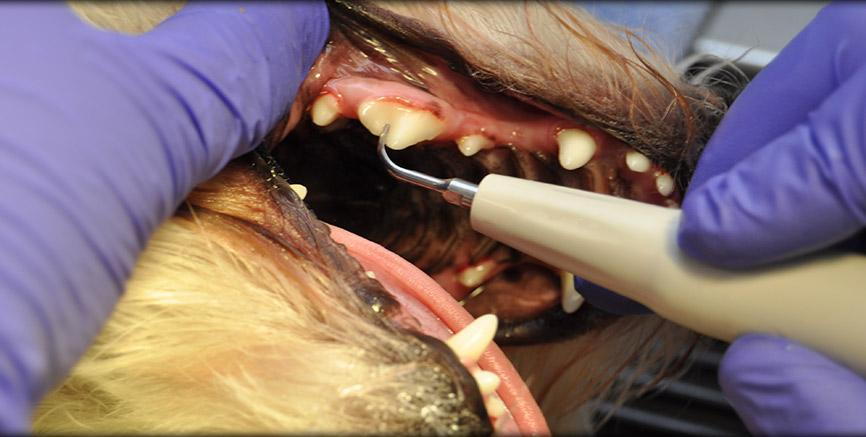
Have you ever taken the time to really take a look in the mouth of your pet? What you see may surprise you. About 85% of pets have periodontal disease by age 3. Our pets do not brush or floss their teeth. You thought morning breath was bad? Imagine what your mouth would look and smell like if you went years without brushing. If you take a look in your pet’s mouth, chances are you may find out.
Normal teeth should be clean and white, with no signs of gingivitis (red and inflamed gums). Saliva, food & bacteria collect on the teeth and underneath the gum line leading to inflammation and infection. This accumulation will invariably result if we do not routinely provide a way for our pets to brush their teeth and disinfect their mouth. Eventually the plaque inside your pet’s mouth will harden and turn into calculus, which cannot be removed with routine brushing or other at home dental care regimens. Calculus then blocks oxygen from contacting the outer tooth and alters the nature of the bacteria in the mouth. This calculus and bacteria will eventually destroy the attachment of the tooth and surrounding bone, resulting in the need for extraction of the tooth. The bacteria in the mouth can also enter the bloodstream through the infected gums leading to infection in the heart, kidneys, liver or anywhere else the bloodstream can carry them. Small breed dogs are at greatest risk for periodontal disease as they have the same amount of teeth as a large dog, only packed into a smaller mouth. This crowding results in rapid development of calculus and even faster development of disease.
At-home dental care is very important to delay the progression of periodontal disease in our pets. We understand that not every pet will tolerate daily brushing, which is why we offer a variety of dental care options for your pet. It is a good idea to become comfortable opening your pet’s mouth and looking inside. If your pet will allow, try to gently lift the lip and look at the teeth, especially the back teeth, as that is where calculus is usually the heaviest. Again, once calculus is present, the condition cannot be reversed with at-home dental care products and a professional dental cleaning will be required.
When looking for dental products for your pet, be sure the product has the VOHC (Veterinary Oral Health Council) seal of approval, as these products have been studied and proven to make a difference.
It is important to note that at-home dental care will not replace the need for a professional dental cleaning, but can delay the need for one if started at an early age and can keep the mouth clean and healthy between professional cleanings. Once calculus begins to develop in your pet you should expect the need for a professional cleaning once every 6-12 months. The hope is that with at-home dental care we can prolong the time needed between cleanings.
Recommend At-Home Dental Care Products:
• CET Enzymatic Toothpaste (my personal favorite): this toothpaste contains enzymes which dissolve plaque and in turn it’s associated bacteria. Even if your pet does not tolerate brushing, this paste can be applied to your pet’s teeth with your finger and then you can let the toothpaste do the work. If your pet will tolerate brushing it works even better!
• CET Chlorhexidine Oral Rinse: One of the most effective anti-plaque agents out there, this easy to use oral rinse combats plaque, freshens breath and promotes an overall healthy mouth.
• CET Hextra Chews (also a personal favorite): These single layer raw-hide chews are easily digestible and impregnated with CET Chlorhexidine Oral rinse. Your pet brushes their teeth as they chew. This chew does wonders for their breath!
• CET Veggie Dent chews: These chews are great for our food allergy patients! They also contain the CET chlorhexidine oral rinse, allowing your pet to brush while they chew. These treats are not as durable as our Hextra chews, so if your pet tends to gobble treats right up, the Hextra chews may be a better option.
• Greenies: Great option on dental treats for our kitties!
• CET Plaque Off: This is a powder which can be mixed with wet or dry food and binds to plaque to prevent build up.
• CET Water Additive: This is a liquid which can be mixed into your pets water which binds to plaque to reduce build up and works great to freshen their breath!
Alex De La Rosa, DVM
- posted: Aug. 26, 2020
Have you ever taken the time to really take a look in the mouth of your pet? What you see may surprise you. About 85% of pets have periodontal disease by age 3. Our pets do not brush or floss their teeth. You thought morning breath was bad? Imagine what your mouth would look and smell like if you went years without brushing. If you take a look in your pet’s mouth, chances are you may find out.
Normal teeth should be clean and white, with no signs of gingivitis (red and inflamed gums). Saliva, food & bacteria collect on the teeth and underneath the gum line leading to inflammation and infection. This accumulation will invariably result if we do not routinely provide a way for our pets to brush their teeth and disinfect their mouth. Eventually the plaque inside your pet’s mouth will harden and turn into calculus, which cannot be removed with routine brushing or other at home dental care regimens. Calculus then blocks oxygen from contacting the outer tooth and alters the nature of the bacteria in the mouth. This calculus and bacteria will eventually destroy the attachment of the tooth and surrounding bone, resulting in the need for extraction of the tooth. The bacteria in the mouth can also enter the bloodstream through the infected gums leading to infection in the heart, kidneys, liver or anywhere else the bloodstream can carry them. Small breed dogs are at greatest risk for periodontal disease as they have the same amount of teeth as a large dog, only packed into a smaller mouth. This crowding results in rapid development of calculus and even faster development of disease.
At-home dental care is very important to delay the progression of periodontal disease in our pets. We understand that not every pet will tolerate daily brushing, which is why we offer a variety of dental care options for your pet. It is a good idea to become comfortable opening your pet’s mouth and looking inside. If your pet will allow, try to gently lift the lip and look at the teeth, especially the back teeth, as that is where calculus is usually the heaviest. Again, once calculus is present, the condition cannot be reversed with at-home dental care products and a professional dental cleaning will be required.
When looking for dental products for your pet, be sure the product has the VOHC (Veterinary Oral Health Council) seal of approval, as these products have been studied and proven to make a difference.
It is important to note that at-home dental care will not replace the need for a professional dental cleaning, but can delay the need for one if started at an early age and can keep the mouth clean and healthy between professional cleanings. Once calculus begins to develop in your pet you should expect the need for a professional cleaning once every 6-12 months. The hope is that with at-home dental care we can prolong the time needed between cleanings.
Recommend At-Home Dental Care Products:
• CET Enzymatic Toothpaste (my personal favorite): this toothpaste contains enzymes which dissolve plaque and in turn it’s associated bacteria. Even if your pet does not tolerate brushing, this paste can be applied to your pet’s teeth with your finger and then you can let the toothpaste do the work. If your pet will tolerate brushing it works even better!
• CET Chlorhexidine Oral Rinse: One of the most effective anti-plaque agents out there, this easy to use oral rinse combats plaque, freshens breath and promotes an overall healthy mouth.
• CET Hextra Chews (also a personal favorite): These single layer raw-hide chews are easily digestible and impregnated with CET Chlorhexidine Oral rinse. Your pet brushes their teeth as they chew. This chew does wonders for their breath!
• CET Veggie Dent chews: These chews are great for our food allergy patients! They also contain the CET chlorhexidine oral rinse, allowing your pet to brush while they chew. These treats are not as durable as our Hextra chews, so if your pet tends to gobble treats right up, the Hextra chews may be a better option.
• Greenies: Great option on dental treats for our kitties!
• CET Plaque Off: This is a powder which can be mixed with wet or dry food and binds to plaque to prevent build up.
• CET Water Additive: This is a liquid which can be mixed into your pets water which binds to plaque to reduce build up and works great to freshen their breath!
Alex De La Rosa, DVM
Location and Hours
720 Kennedy Dr, Metropolis, IL, 62960
Monday
8:00 am - 5:00 pm
Tuesday
8:00 am - 5:00 pm
Wednesday
8:00 am - 5:00 pm
Thursday
8:00 am - 5:00 pm
Friday
8:00 am - 5:00 pm
Saturday
Closed
Sunday
Closed
Location
Find us on the map
Metropolis Office
720 Kennedy Dr
Metropolis, IL 62960